

Be there any greater honor… for a brand than to get mentioned in Mad Men? We’ve garnered our share of pop-culture spotlights and potshots, it’s true. But a cameo, however brief, in this exquisitely written and painstakingly researched portrait of 1960s New York is ample proof of one’s midcentury cultural bonafides. What if the work shown isn’t ours and never existed? Details, mere details.
It happens in episode 3 of season 5, “Tea Leaves”, originally aired April 1, 2012. Copywriter Peggy Olson (Elizabeth Moss), tasked with hiring a new copywriter for the ad agency Sterling Cooper Draper Pryce, comes across a portfolio that catches her eye. On the outside of the leather case is the winking admonition “Judge not, lest ye be judged.” Inside is a striking newspaper ad for none other than yours truly.
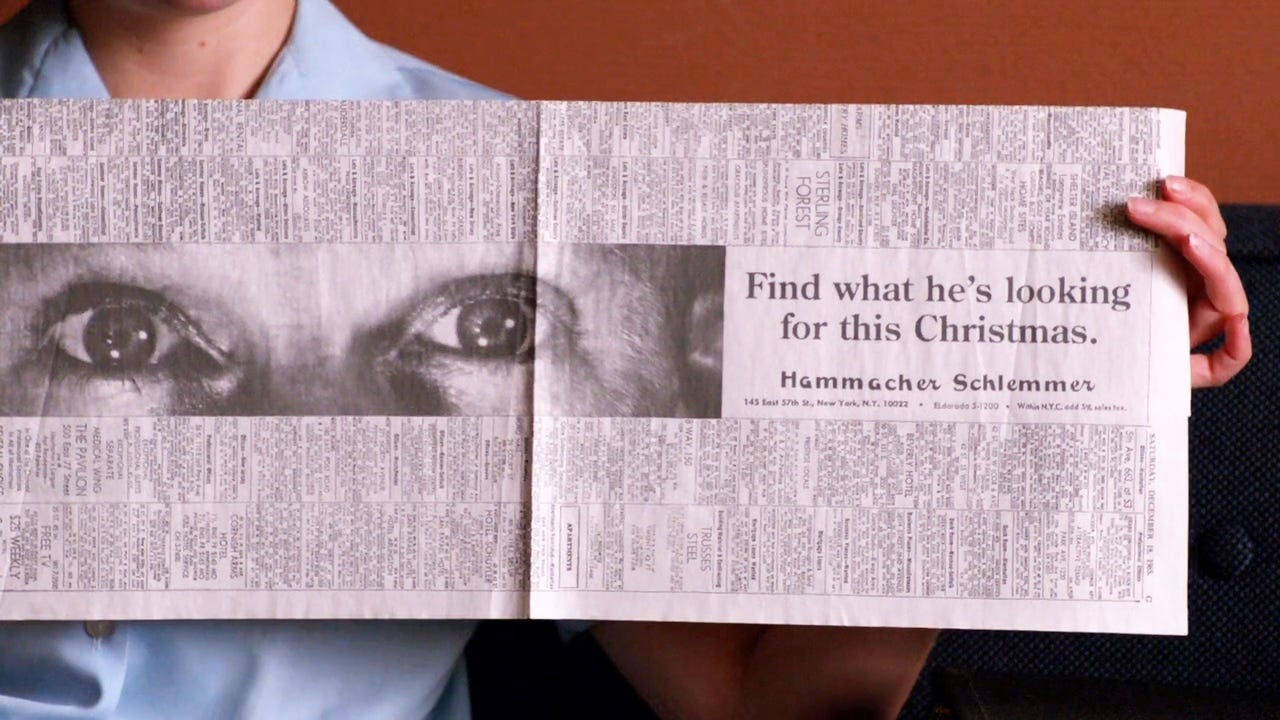
Tearing through the entire center third of a page of classifieds, the perpendicularly-oriented ad shows a close-up of a man’s eyes, the slogan “Find what he’s looking for this Christmas”, and our logo and contact particulars. “Have I lost my sense of smell or is this good?” Peggy asks her brash creative partner, Stan Rizzo (Jay R. Ferguson). “Oh, that’s bitchen,” Stan says approvingly, using a slang term that would indeed have been current at the time (we shouldn’t have doubted it).
This turns out to be our introduction to Michael Ginsberg (Ben Feldman), the show’s boldest exemplar yet of the agency’s (and the country’s) tussle between young and old. As Matt Zoller Seitz puts it in his excellent book Mad Men Carousel, the “grating” Ginsberg’s “provocative portfolio, prankster idiot-savant stylings, and ‘I’m not a jerk, I’m just honest’ routine” set him up as “the future of masculine American ideals” in a way that is “specifically mid-Sixties”. The ad itself belongs to the “Creative Revolution” that was changing advertising in the mid-to-late ‘60s: a bold image, one line of copy, the details left to the imagination.
It also can’t be an accident that the copywriter shares a last name with poet Allen, the best-known bridge between New York’s Beat scene and the countercultural ferment from which hippies will emerge. Eventually this hiring will turn out to be a mistake for both Ginsberg and the agency, but at this point in the story, Peggy and Stan see him as a kindred spirit.
Like the rest of Mad Men, the scene mixes fiction and historical fact. The true part is that we were indeed regular advertisers in the New York Times through this period, always in the first 30 or so pages of their famously Brobdingnagian Sunday edition, and often other days of the week as well. Our logo is period-correct and the address and phone number are not only accurate, but judging by the typeface, taken directly from one of our ads.
The fiction is the advertisement itself. We never ran this or anything remotely like it. In our real, more conventional newspaper ads of the time, the products were the stars. They were essentially mini-catalogs. We dug up our actual Times ad from the day on the one in Ginsberg’s portfolio, December 18, 1965, the last Saturday before Christmas. It couldn’t be more different from the Mad Men effort, crammed with small type touting some two dozen specific products. The Creative Revolution never quite made it to Hammacher; we were too busy selling things.

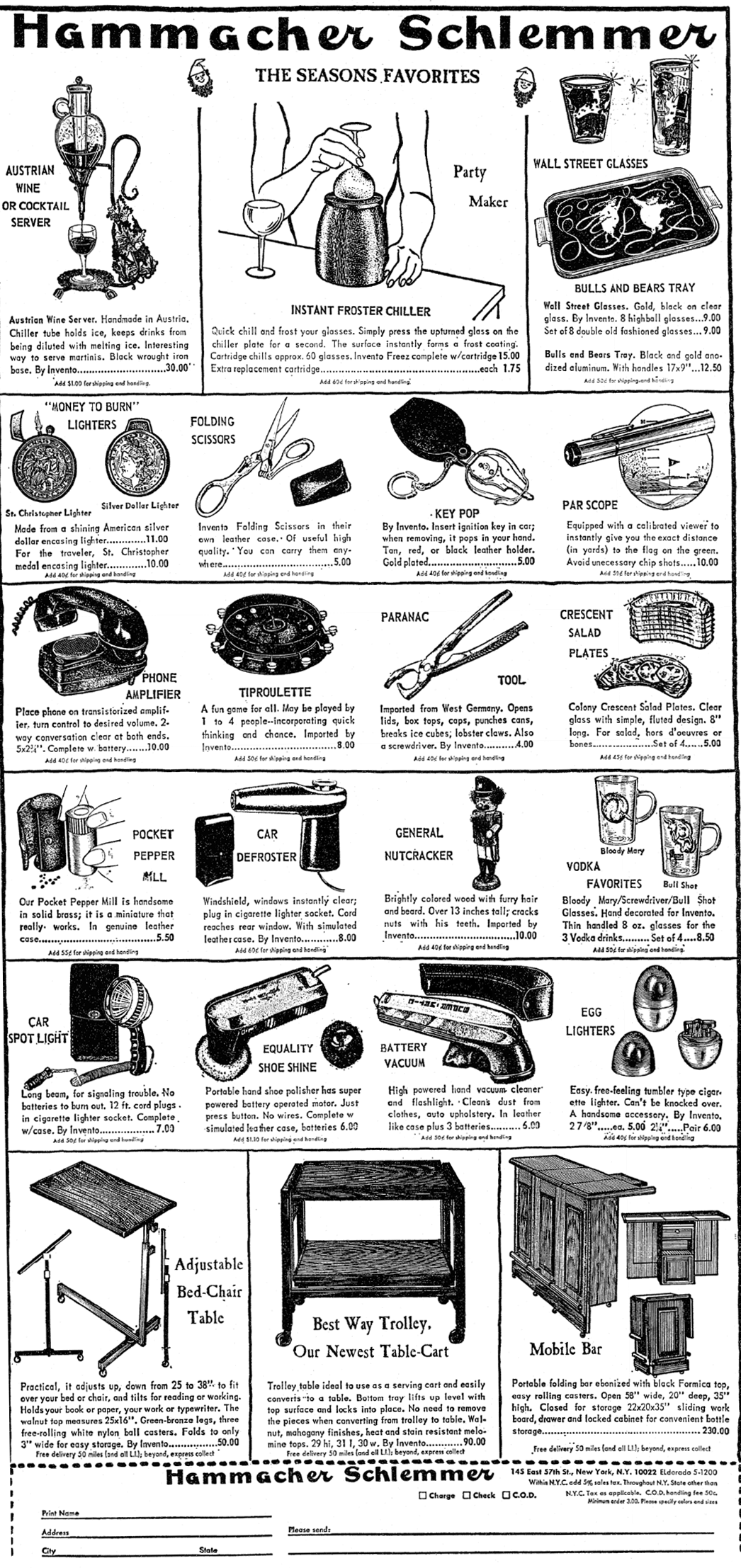
But what of it? We’re deeply flattered that the creators of one of our favorite shows considered us the kind of unorthodox brand that would’ve run an ad that bold, even though we never did.
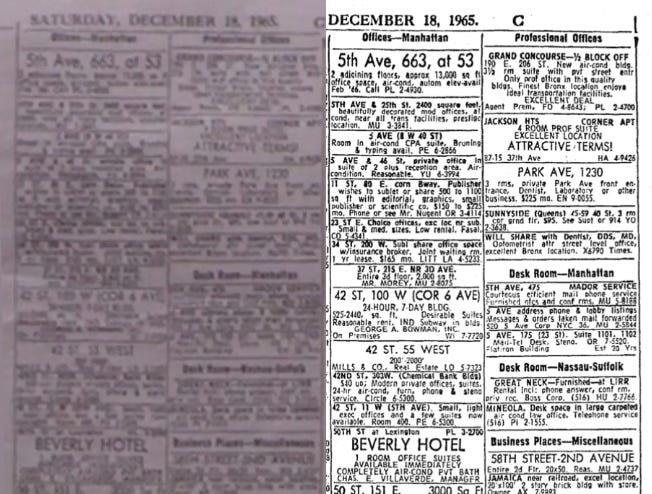
Oh, and remember what we said about Mad Men‘s meticulous research? Well, we couldn’t help but check on the actual classified ads from that day’s Times. Sure enough, the page on the show matches the real page 51 from December 18, 1965. That’s what we mean by “painstaking”.
The Bulls & Bears Wall Street glasses and tray set is actually pretty cool, even (maybe especially?) in today's world.
Hammacher Schlemmer uniqueness and greatness was in major part because of lifetime guarantees. I bought stuff for that reason. Now Hammacher Schlemmer is no longer upholding that guarantee. Whatever reason they give for not being able to uphold guarantees does not matter to me. They bought the company; they bought the guarantees - that comes with the name. I can prove I bought from them, but they just say sorry, we won't help you.
New buyers see their lifetime guarantee now and buy into it. Good luck with that. This feels like a huge scam to me. Buy a company with a reputation based on lifetime guarantees and then don't honor the guarantees to reduce the expense of following through on the guarantees.
I have proof of purchase, and they won't honor the promise. They are now Hammacher Schlemmer. Awful. I will no longer buy from them. They know exactly what they are doing to us.