

Right on the money… “C. Tollner & Hammacher Hardware,” the copper coin says, using our then-current name as of 1863, “Bowery, New York”. Flip it over, and you can see that the dry Hammacher Schlemmer sense of humor was already evident even at that early date: “Not One Cent”.
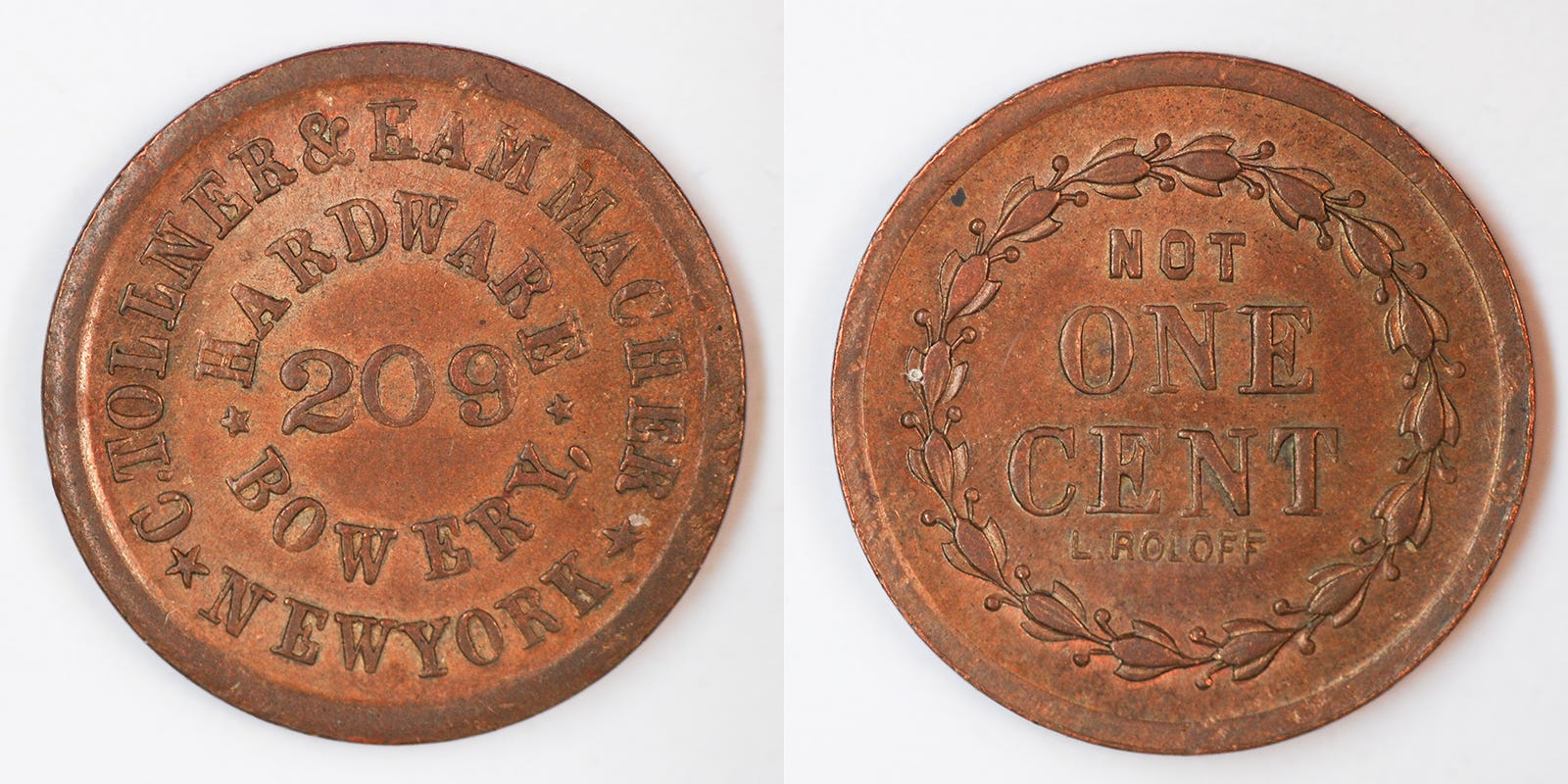
Was this bespoke currency used as real money? Kind of. Or at least, up until 1864, it wasn’t specifically prohibited by law. Tokens like this were a widespread response by merchants to the shortage of small-denomination coins during the Civil War.
Imagine the shock in 1861, when the war started. Suddenly, after decades of peace in most of the country, stability couldn’t be taken for granted. In such times, people hoard precious metals. That’s what was happening to U.S. coins, many of which did, at the time, contain appreciable amounts of gold and silver. It wasn’t long before copper and nickel coins started vanishing from circulation, too.
This was a problem for merchants when it came to making change for their customers. So by 1862, they started minting their own pseudo-pennies, often called “store cards” by collectors, despite being, very visibly, coins and not cards. I’m calling them “tokens” because calling coins “cards” is more cognitive dissonance than a man my age should be expected to handle.
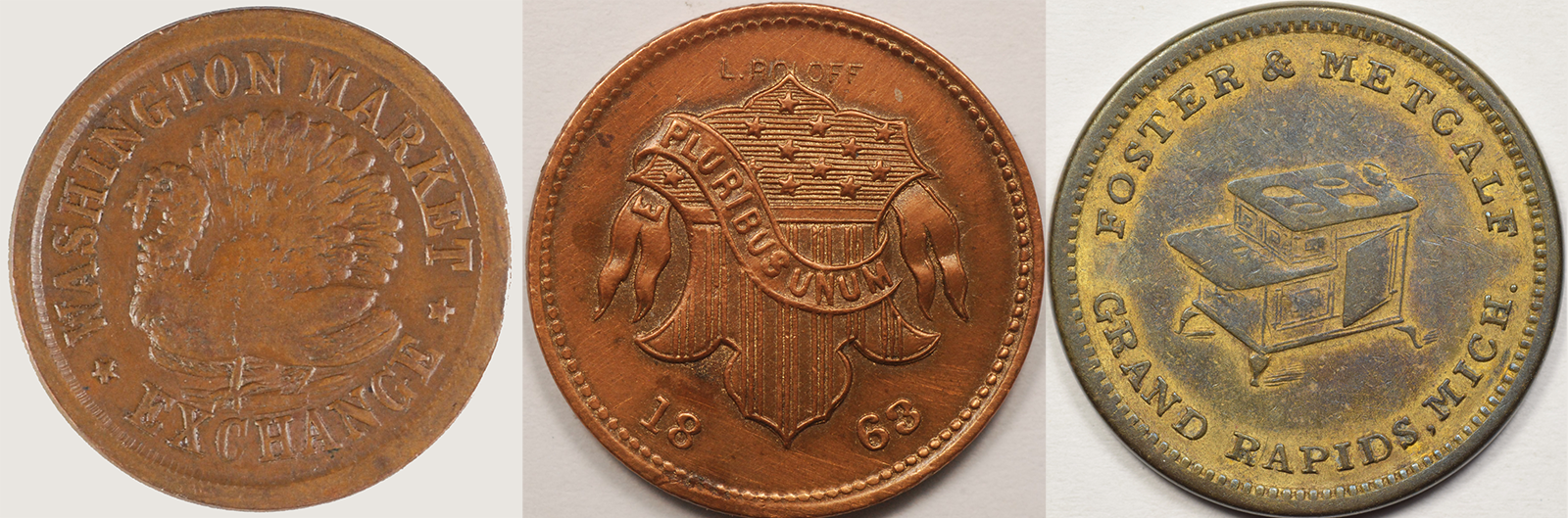
One of the first collector guides to store tokens, published in 1924 by George Hetrick and Julius Guttag, lists thousands of examples from both sides of the Mason-Dixon line. Designs ran the gamut from simple garland-and-text designs, like ours, to illustrations of the merchant’s products or patriotic symbolism. Ads and flags: my country, ‘tis of thee.
Along with hardware stores like us, the coiners included hotels, restaurants, bakeries, grocers, tobacconists, jewelers, dairies, haberdasheries, at least one sausage maker, and the City of New York itself. I’m not sure how customers felt about getting one of these instead of a real penny in change. But if there were no other coins to be had, and their other choice was nothing, I guess they made their peace with it.
Why wasn’t this counterfeiting? Because the tokens were officially just store credit, only redeemable for future purchases at that store, and of course merchants have the right to issue store credit. But the dearth of government coinage, and the general chaos of pre-industrial wartime society, meant merchant tokens inevitably leaked out into pockets that would never go near the store in question.
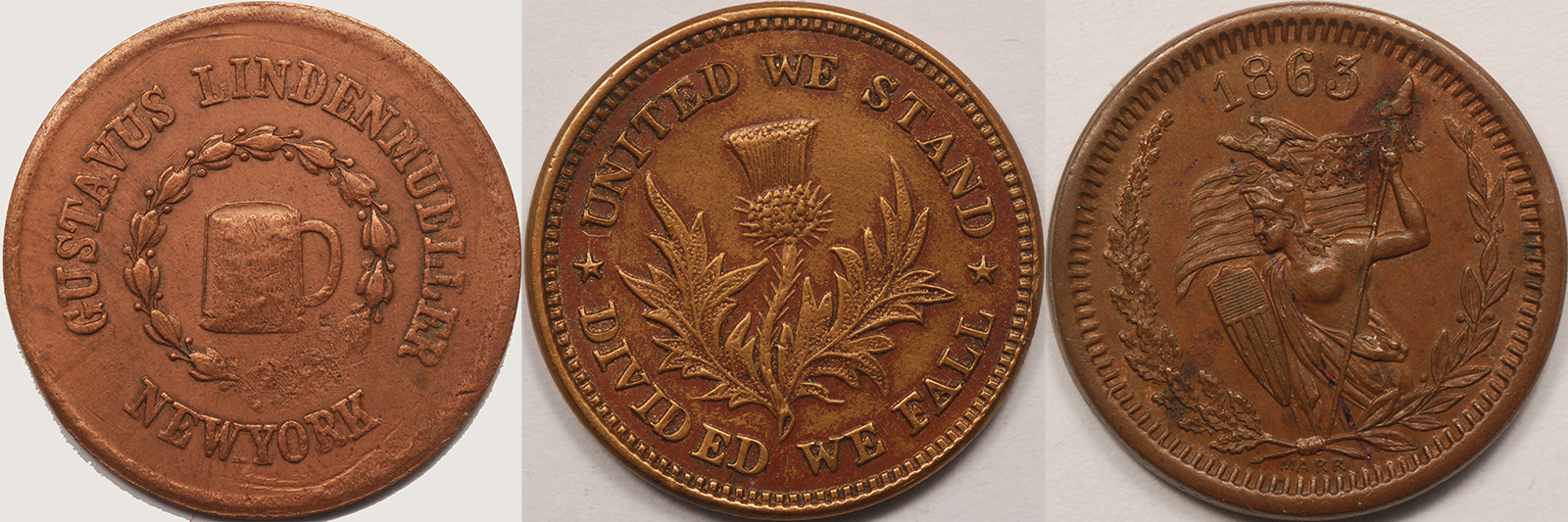
Which sometimes was by design. New York brewer Gustavus Lindenmueller issued a million store tokens (shown at left above) to advertise his beer, according to Hetrick and Guttag, which were widely accepted in the city for such transactions as train fares. But they say that when the Third Avenue Railroad tried to cash in the pile of Lindenmueller tokens they’d collected in their fare boxes, “this he laughingly refused to do. The railroad had no redress, and it is not improbable that incidents of this character forced the Government to put a stop to their issue.”
It’s an amusing story, but I couldn’t find any mention of it in newspapers of the time. In any case, the U.S. government did indeed ban the practice in 1864. It probably helped that despite the war, production of real pennies was at an all-time high, peaking at 49.8 million pennies in 1863, helping relieve the shortage as they spread into circulation.
Thus ended our little foray into minting money. If we’d held on to some of those Tollner & Hammacher “Not One Cent” tokens, they’d each be worth $65 now. With that kind of return on a one-cent investment, we could get out of the store business altogether.
One cent won’t get you much at Hammacher Schlemmer these days, but you might be surprised how far your penny jar can take you in our Clearance section.
And if you like Gnomenclature, you should know about Shoddy Goods, Jason’s other newsletter. It tells similar stories about consumer culture and history, but drawn from the rest of the world outside Hammacher Schlemmer. It’s about as fun as your Inbox can get.