

When you feel the need for spud… you also need patience to wait for that potato to bake. That’s why potato nails are a thing: you drive it into your tuber of choice and it conducts heat to the center of the potato, cooking it more quickly and evenly. Or so the story goes. Potato nails only speed up baking by about 10%, although some users say it also makes for a fluffier texture.
So when I spied this High-Speed Potato Baker in our fall 1981 catalogue, promising to cut the baking time in half, my curiosity was piqued. Assuming that we were, as always, telling the truth, why did it work so much better than other potato nails? And why would we ever stop selling such a miraculously effective device?
I would find that both questions have the same answer: Freon.
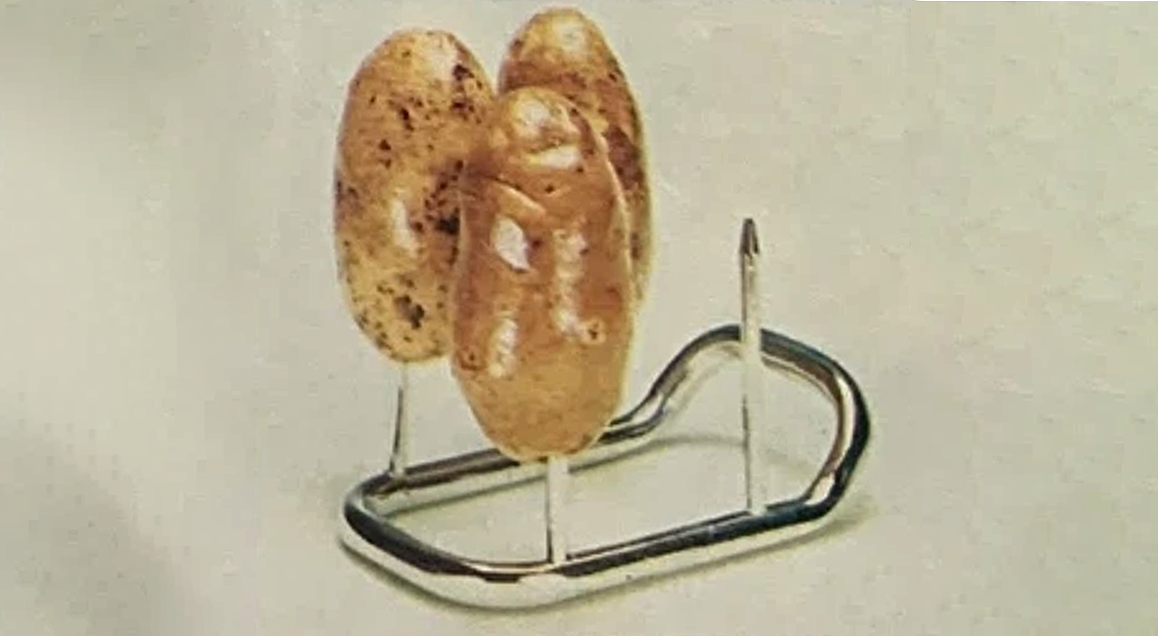
As patented by William Perez in 1958, “Thermal Pins” are hollow metal skewers with “liquid in the pin that quickly evaporates for delivery throughout the extent of the pin” and then condenses and starts the whole evaporating/condensing cycle again. I don’t pretend to really understand the physics, but suffice to say, the kinds of chemicals sold under the brand name Freon were more efficient at absorbing and releasing heat in that chamber than a solid piece of steel would be. So the spike gets hotter and the potato cooks faster.
Marvin Spath then entered the picture. As a marketing executive at Westinghouse, Spath had helped introduce that firm’s appliances to Europe after World War II. He formed the Thermo Pin Corporation around 1959 to commercialize Perez’s invention and explore other applications of the idea. The initial Thermo Pins, which were about the size of an arrow and had similar fins on the end, were intended for cooking large meat roasts. At some point, the Freon-chamber concept was adapted into the four-pronged potato baker, sans fins.
Initially, Spath peddled his wares to restaurants and commercial kitchens, where time is most keenly of the essence. By the early 1970s, Thermo Pin had its eyes on your kitchen, too. Hammacher Schlemmer was one of the select retail outlets that recognized its potential.
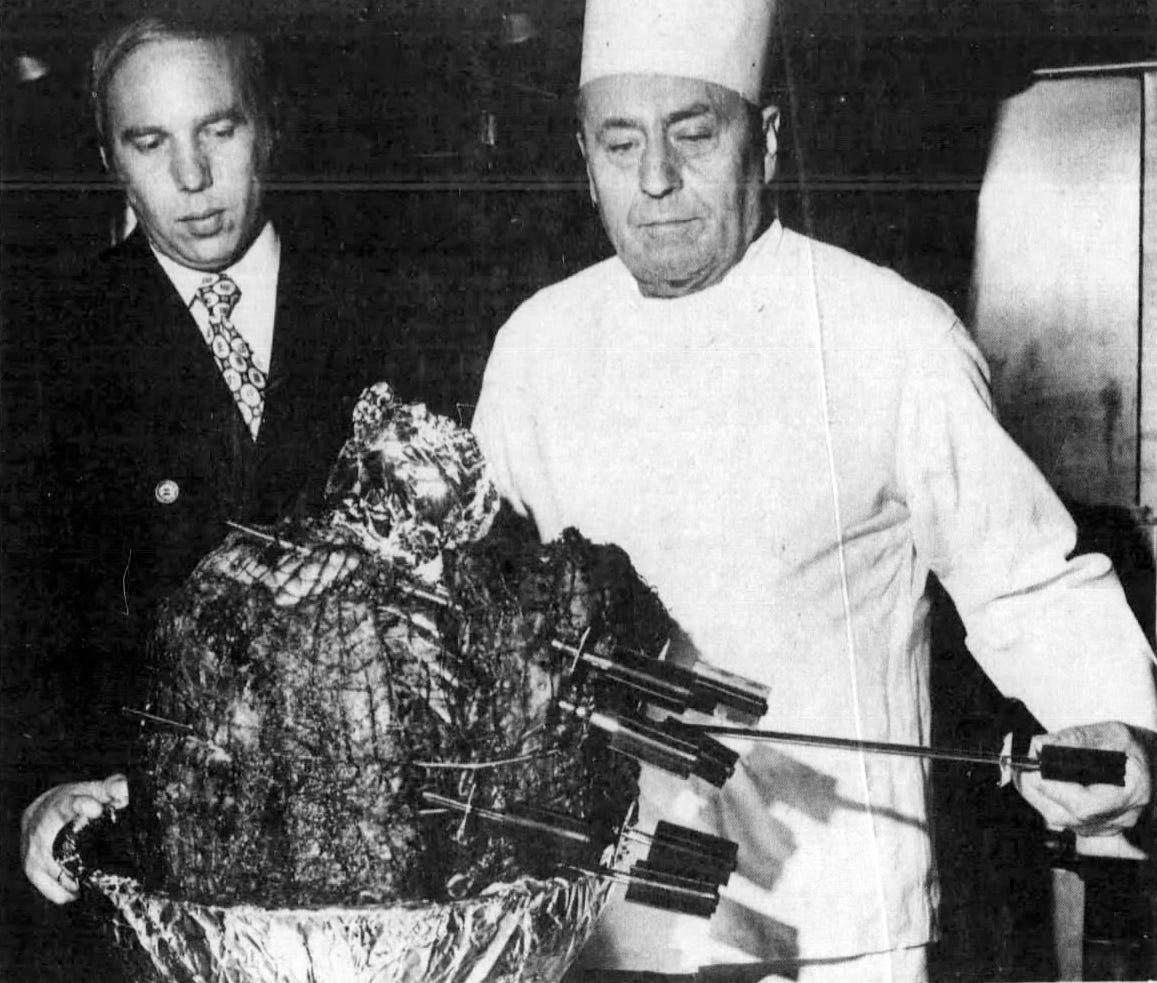
Did it work? “The Thermo Pins cut the cooking time [for a baked potato] down to about 25 minutes, which is great for us,” Hans J. Hoelzer, director of operations for New Jersey’s Governeur Morris Inn (and the figure at left in the photo above), told the Morristown Daily Record in 1975. “By the time they have their soup and appetizer, the potatoes are done.”
The New York Times‘ Pierre Franey mostly agreed. “The thing does in fact work,” he wrote in 1980. “The other evening as I cooked some potatoes using the prongs and some without them, there was no question but those on the prongs were cooked faster. It is my impression, however, that the manufacturer’s assertion that the prongs bake potatoes in half the usual time is inflated.”
Scientific American‘s conclusions in their June 1980 issue were more rigorous but just as mixed. They found that a full-size Thermo Pin reduced a potato’s baking time by 26%, but the potato baker’s vertical orientation canceled out the positive effects because a vertical potato exposed less surface area in the direction of the oven’s heating elements. “One might do better by placing the potato horizontally over the coils.” Potatoes with potato nails, incidentally, cooked no faster than those with no extra heating elements at all.
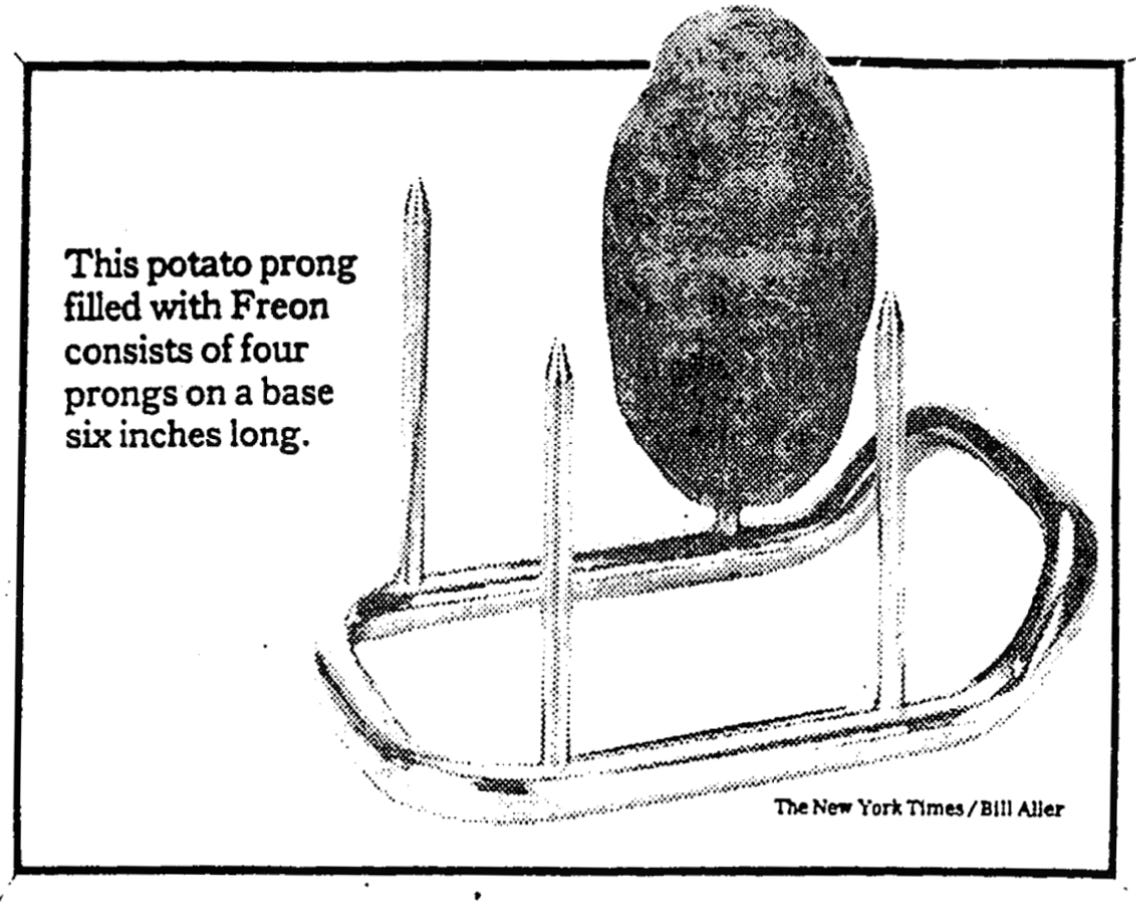
But the Freon that made the High-Speed Potato Baker effective would eventually make it illegal. The Montreal Protocol was signed by 198 countries on September 16, 1987. It stipulated a worldwide phase-out of the chemicals most responsible for ozone depletion. Chief among them were chlorofluorocarbons and hydrochlorofluorocarbons, like most of the products sold as Freon.
Looked at one way, the High-Speed Potato Baker was a small, relatively affordable ($15, about $60 today) item that could cut at least a quarter off the time of one of the home cook’s slowest processes. Looked at another way, how many baked potatoes does one have to eat to make it worth 60 bucks to save 20 minutes on each one? The Freon ban made such calculations moot. The High-Speed Potato Baker is one Hammacher Schlemmer classic we won’t be reviving.