

Oh, the stories Hammacher Schlemmer could tell… that’s why Gnomenclature exists. Every week, we’ll rummage through the deep, dense substrata of our 178-year history to tell the best stories from Hammacher’s past and present.
What makes me, as the writer with that assignment, positively salivate is all the ways Hammacher Schlemmer connected to the very heights of pop culture through the 20th century. Those heights don’t get much higher than the Beatles. And it’s just about possible that we inadvertently contributed to the breakup of the greatest band of all time. Oops.
“It blinks and that’s all”
“It’s for the man who wants nothing and is ready to pay a good, stiff price for it,” Hammacher Schlemmer president Dominic Tampone told the New Yorker in 1962. He was talking about the Nothing Box, a six-pound metal box festooned with eight small lights that blinked in a random, meaningless sequence. “Sells for twenty-five dollars,” he continued (about $265 today), “and we expect to dispose of a thousand of them by Christmas Day.”
The catalog copy for the Nothing Box stresses its complete lack of features or, indeed, purpose. “It blinks and that’s all… Let us warn you that unless you use an axe you can’t turn it off. It will keep on winking its 8 eyes in no recognizable pattern and for no apparent reason for nearly a year. Then it’s dead as a mackeral and you can’t get it fixed.”
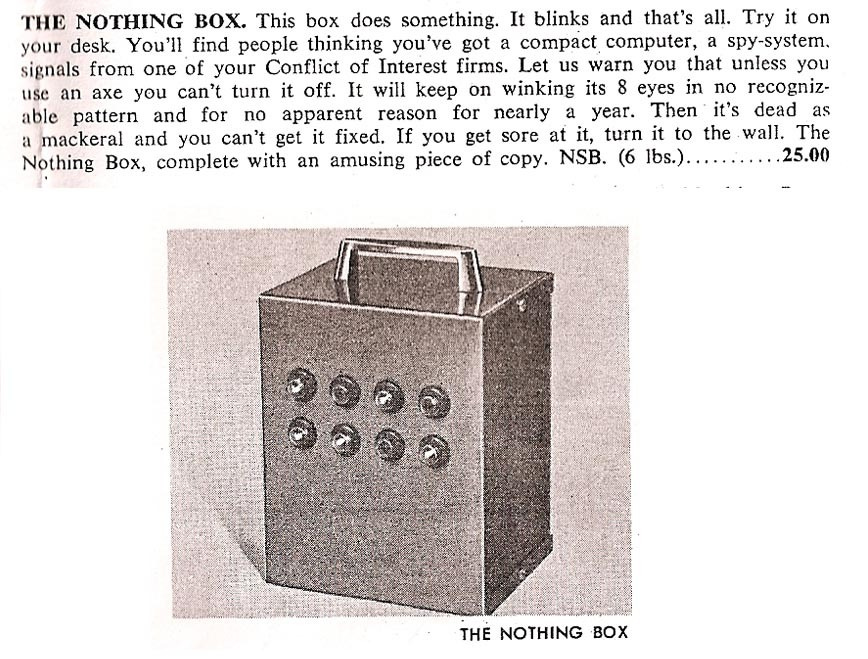
The New Yorker had questions. What else did it do? Nothing. What did it all mean? Nothing. What was the point? The fun of wondering what the point is, of letting your mind conjure up its own narrative about what’s going on. “The box seems to give back every bit as much as you put into it,” Tampone said. “I find myself talking to it now and then, and the lights seem to respond. In my imagination, it tells me what’s doing on the main floor, the second floor, the third, and so on. It gives an executive like me an executive feeling—a sense of being in charge, of being on top of things.”
As Hammacher Schlemmer’s deepest excursion into pure dada absurdism, the Nothing Box was years ahead of its time. And it would soon attract the attention of another famous creative innovator with a taste for the silly and surreal.
Along comes a guru
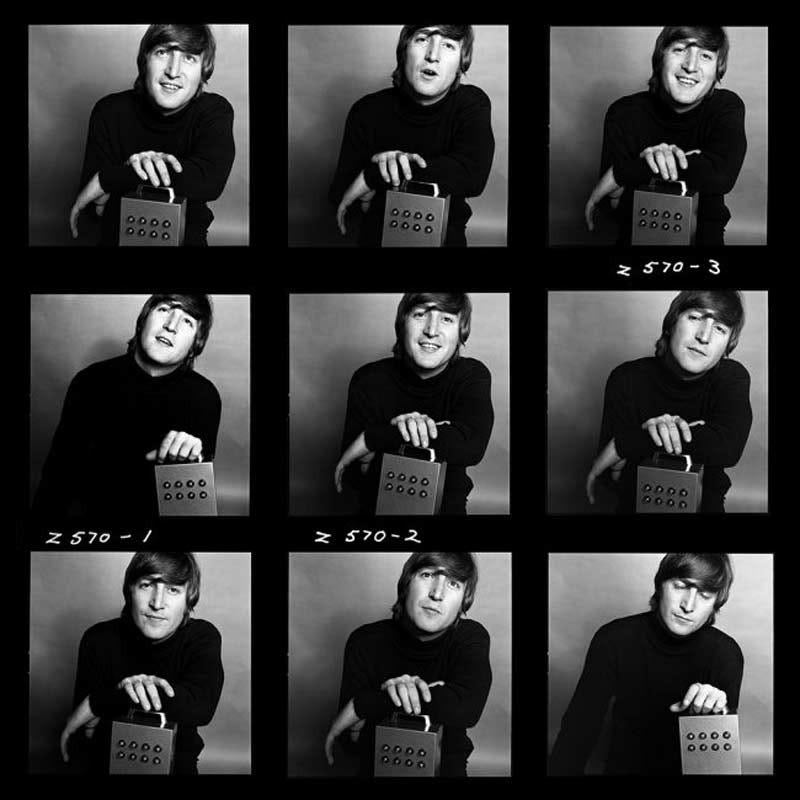
John Lennon was captivated. One of the “kinetic light sculptures” on display at the Indica Gallery in London in early 1966 was a simple box with eight flashing lights. This “Nothing Box” tickled the famed Beatle’s sense of absurdity and he bought one on the spot. One of his friends, either Rolling Stones guitarist Brian Jones or gallery owner John Dunbar, introduced him to the (supposed) artist, Yannis Alexis Mardas, or Alex for short.
The 23-year-old son of a Greek military officer turned on his apparently considerable charm. Lennon was impressed by Mardas’s big ideas, like wallpaper with speakers built into it, or a typewriter that could automatically transcribe music - all redolent of the far-out early-psychedelic atmosphere of Swinging London. He dubbed Mardas “Magic Alex”, called him his “guru”, and started spending hours at a time tripping on LSD and staring at the Nothing Box, which numerous stories ever since have credited as a Mardas invention.
But in photos of Lennon posing with his Nothing Box, it’s identical to the one in Hammacher’s catalog, down to each rivet. Nothing about Magic Alex’s past or future endeavors (more on that in a moment) would indicate he had the technical knowledge or fabrication skill to even craft a knockoff, let alone invent it himself.
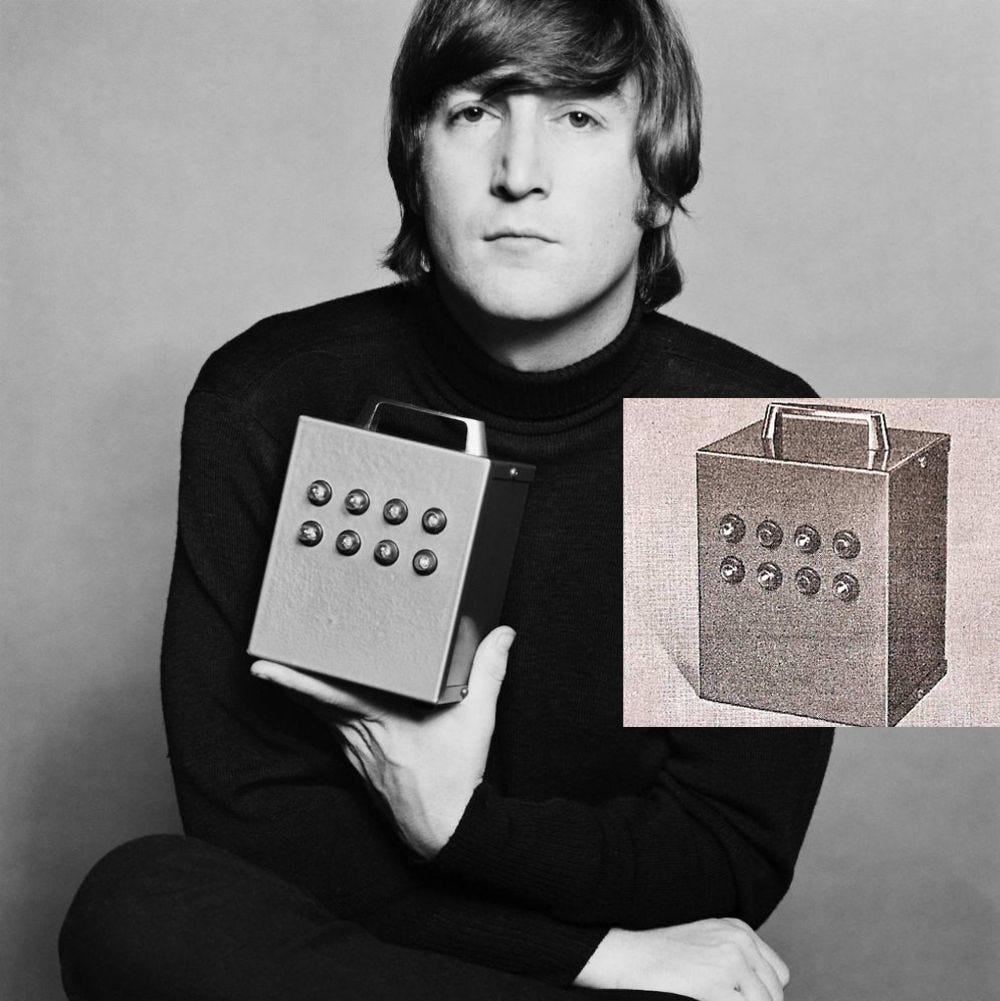
If there’s any doubt about the provenance of Lennon’s Nothing Box, in a February 1966 New York Times story, Dominic Tampone tells the paper that Hammacher Schlemmer sent six Nothing Boxes to the Beatles. In any case, two things seem clear: John Lennon’s Nothing Box came from Hammacher Schlemmer, and he (and others) gave Alex Mardas the credit for it.
That matters because the Nothing Box was Mardas’s entree into the world of the Beatles. Most of the band treated him with casual amusement. “I thought he was just some guy with interesting ideas,” Paul McCartney said. But for Lennon, Magic Alex became a ubiquitous tag-along, from the recording studio to family vacations. In a matter of months, Mardas went from a semi-employed TV repairman to the personal guru of one of the biggest stars in the world,
In 1968, the Beatles launched Apple Corps, their loosely utopian “company”. Magic Alex was hired to head up Apple Electronics despite his proud lack of any technical expertise. “Now I’m doing electronics. Maybe next year, I make films or poems,” he said. “I have no formal training in any of these, but this is irrelevant.” Ideas like color-changing paint or a “robot housewife” sounded reasonable in the chemically-enhanced carnival atmosphere of Apple Corps. Mardas’s repeated and expensive failures to deliver any of his trippy visions were just part of the show.
“From bad to worse”
More serious was Mardas’s complete inability to build even a rudimentary recording studio. His previous unrealized inventions were trifles: who really cared if he couldn’t install an “artificial sun” over the Apple Boutique? But the Beatles were planning their recording career around Mardas’s promise to build a “72-track studio” (when the state of the art was eight tracks) at Apple Corps headquarters. This was serious. Without more hit Beatles records, the whole enterprise would fall apart.
After months of construction and hundreds of thousands of pounds spent, the studio was “the biggest disaster of all time,” in George Harrison’s words. It lacked basics like soundproofing and cable ports between the studio and the booth. The heating and cooling systems roared loudly enough to be captured on tape. The disaster site was only made semi-usable when the band’s longtime producer, George Martin, quickly had some actual recording gear installed.
By now even Lennon was running out of patience for Mardas’s antics. “I brought in Magic Alex and things went from bad to worse,” he would later ruefully admit. When skull-cracking old-school manager Allen Klein took over the Beatles’ affairs, Magic Alex was one of the first to go. Of course, the Beatles themselves would collapse not long after, into a sordid mess of feuds and lawsuits. The financial disaster that was Apple Corps was at the center of this sad coda to the Beatles’ story.
Maybe the Nothing Box did have one practical use: as the calling card for a conman. And while Magic Alex didn’t accomplish anything much, he did contribute mightily to the financial crisis and general chaos that strained the Beatles past the breaking point. Too bad for the rest of us that John Lennon didn’t get his Nothing Box direct from the source.
Alas, we don’t have any more Nothing Boxes in stock. But denizens of the intersection of technology and absurdity might enjoy The Canine Communication Push Buttons. They’re even more absurd if you don’t have a dog.