

Those carefree days of yore… weren’t always so carefree. Autumn of 1961 was a particularly nerve-wracked time even by anxious Cold War standards. The cement had scarcely finished drying on the Berlin Wall before US and Soviet tanks would face off at the Brandenburg Gate, teetering on the edge of war for two days in late October. Closer to home, the political temperature in the Caribbean was still blistering after the US’s failed Bay of Pigs invasion of Cuba in April. The public mood was jittery.
In this tension, Hammacher Schlemmer chairman Dominic Tampone saw opportunity. A market for home fallout shelters had sprung up almost as soon as the last war ended. Now seemed like the right time for Hammacher to get into the act - and for the born showman Tampone, then only two years in the top job, to put his stamp on the company.
“Rather than a hole in the ground”
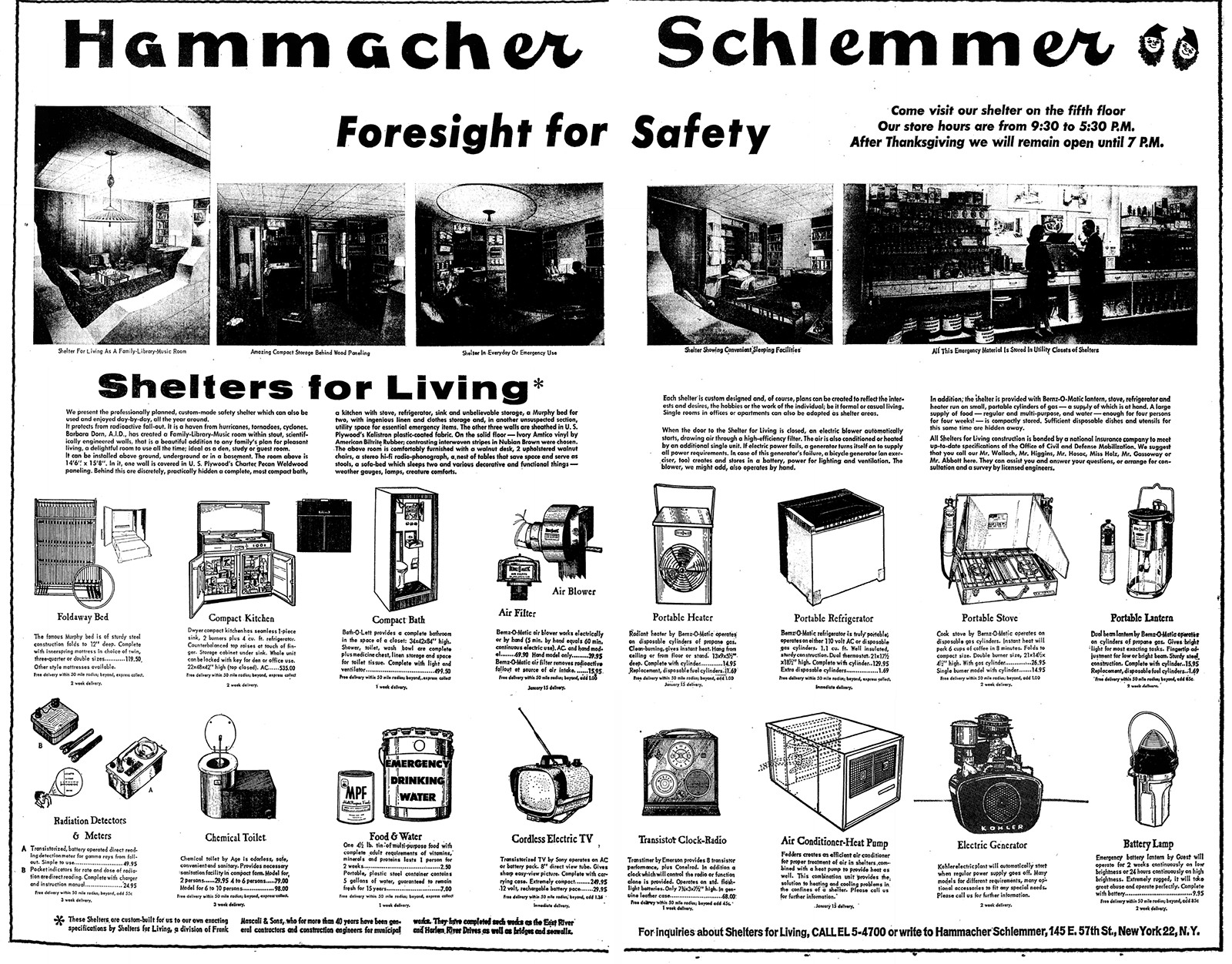
A model survival shelter was set up on the fifth floor of the Hammacher Schlemmer store at 145 E. 57th St. in Manhattan. In just as significant an investment, a two-page advertising spread in the Sunday New York Times was devoted to these “Shelters for Living”.
But of course, these weren’t just any shelters. “Since there’s only an outside chance that the room will be needed for a national emergency,” Tampone later said to a Times reporter, “why not build a room with emergency features that will add a comfortable and enjoyable living space to the house? A rumpus room, or a library-living room, or whatever suits the family.”
“This makes more psychological sense. If it has to be used for emergency, it is better to have a room the family is used to enjoying, rather than a hole in the ground to crawl into.”
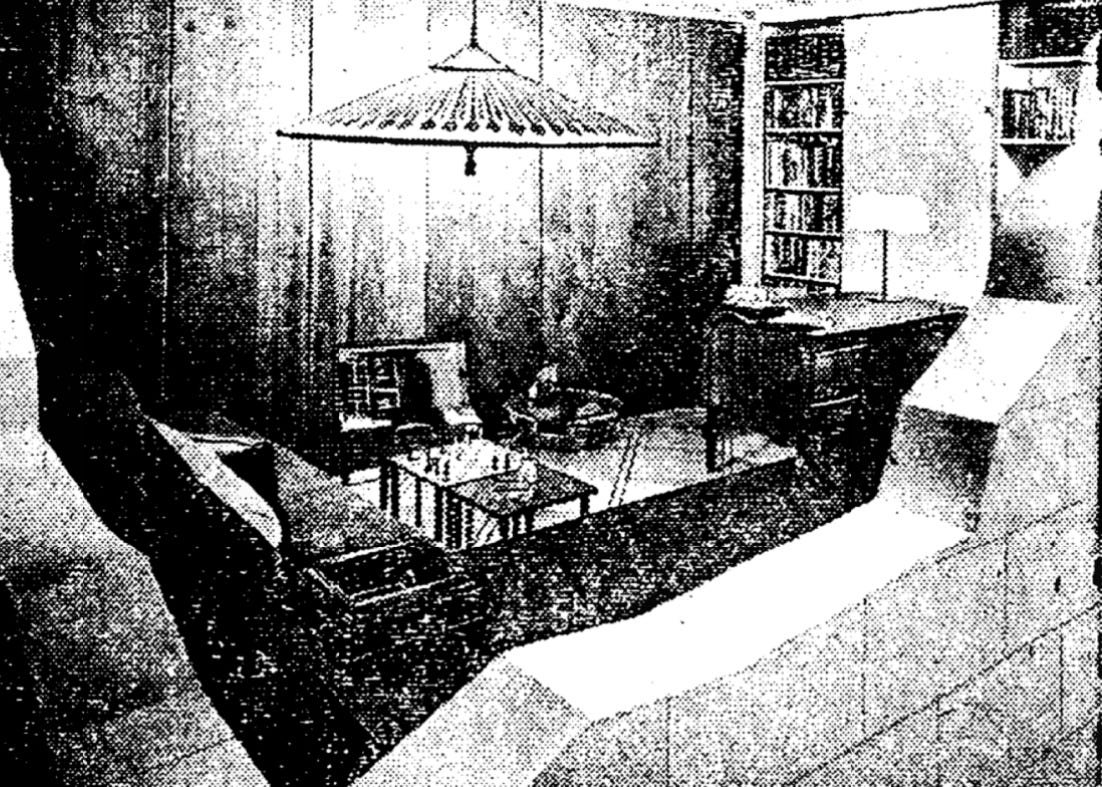
That’s exactly the angle that Hammacher’s shelter ads took. “Ideal as a den, study, or guest room,” these were “professionally planned, custom-made safety shelters which can also be used and enjoyed day-by-day, all the year around.” Alas, the only photos we can find are the grainy ones from the ads. (If anyone out there has any more, please email this author!) On that evidence, they do indeed look pretty much like a midcentury rumpus room, aside from the foot-thick walls.
“Plan for pleasant living”
With typical Hammacher attention to detail, the ad lists the model shelter’s brand-name finishes, from walls covered in “US Plywood’s Kalistron plastic-coated fabric” to the floor of “Ivory Amtico vinyl by American Biltrite Rubber” with “contrasting interwoven stripes in Nubian Brown.” Noted interior decorator Barbara Dorn “has created a Family-Library-Music room within stout, scientifically engineered walls, that is a beautiful addition to any family’s plan for pleasant living.”
Should the living turn somewhat less than pleasant, the shelter “protects from radioactive fall-out” along with more prosaic disasters like hurricanes. “All Shelters for Living construction is bonded by a national insurance company to meet up-to-date specifications of the Office of Civil and Defense Mobilization.”
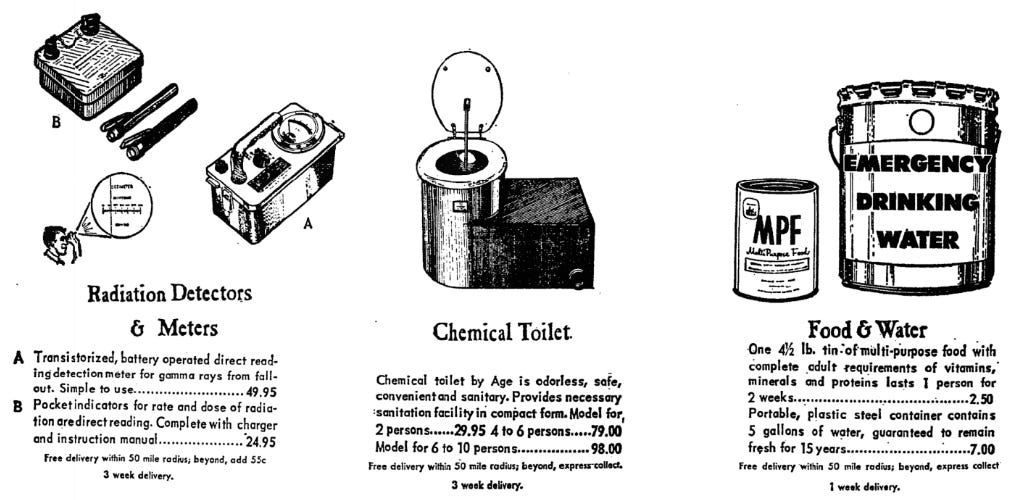
Of course, this being Hammacher, the gadgets take center stage. With a reputed total price of $20,000 (about $215,000 today) putting this shelter out of reach of anyone this side of the Vanderbilts, the real value of the model shelter is as a display setting for the much more affordable accoutrements to the coming apocalypse.
A pocket radiation detector would have set you back $24.95, while a more full-featured model rang up at $49.95. A Sony cordless TV with 8” screen was $249.95, assuming there’d still be anything on worth watching.
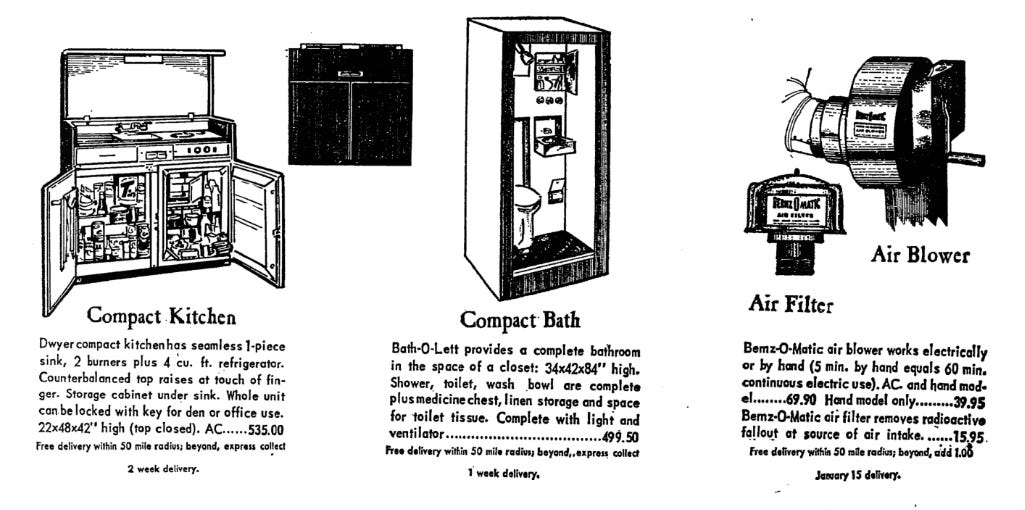
A basic chemical toilet was $29.95, but for those nuclear survivors of more refined disposition, a “Bath-O-Lett” - a shower, sink, and toilet in a closet - was a steal at $499.50. A similarly conceived Dwyer compact kitchen came in at $535 for a sink, two-burner stove, and 4 cubic-foot refrigerator. As with the shelters themselves, the prices for the air conditioner and generator were available by inquiry only. (Multiply all these prices by about 11 to get a rough estmate of cost in today’s dollars. We didn’t want to cram too many numbers in here.)
“The Tiffany’s of civil defense”
Was it a success? In truth, we came late to the party. By the mid-1960s, the shelter’s half-life was fading: a City of Houston clerk reported in 1965 that the city hadn’t received a building application for a home fallout shelter for over a year. The fad had always been more sound and fury than substance in any case, with perhaps only 200,000 home shelters ever being built in the entire country.
So Hammacher Schlemmer was never going to get rich in the shelter business. But in the terms that were probably more important to Tampone - publicity - the model shelter did its job.
The irony of a luxury fallout shelter was irresistible. Hundreds of newspapers across the country took note. Even if the coverage often struck a sardonic note - star syndicated columnist James Reston called us “the Tiffany’s of civil defense”, and said the portable TV would be ideal “to catch all those late late late shows during the Soviet air raids” - we sense that Tampone was probably in on the joke.
But was the whole thing in bad taste? “A few people were shocked at the idea of Hammacher Schlemmer’s advertising shelters and wrote me in very strong terms,” Tampone told the Times. “I was very sorry about it... I should have known it was a controversial subject-it made me quite despondent.” But he went on to say that the favorable response went beyond anything he had imagined. We’re sure the impish impresario Dominic Tampone was anything but despondent about that.
Sorry, Shelters for Living are currently out of stock indefinitely. But The World’s First Breath Meditation Game Tool can help you find peace amidst today’s anxieties.
Our neighborhood was established in the 1950s and we do have a neighbor who has what appears to be a fallout shelter in their backyard. There’s a concrete hatch with a wheel handle to it. I don’t know them, so I’m not going to go over and ask, but I’ve always wondered what it’s like in there…