

The Cold War… wasn’t just a contest of missiles and spies. It was also fought with dishwashers, nylons, and chocolate, as both the United States and the Soviet Union sought to prove they enabled a better life for the average person.
In January 1958, the two nations agreed to host exhibitions by the other, “as an effective means of developing mutual understanding.” Of course, each promoted the “understanding” that their economic system was superior. But it was still an unprecedented glimpse through the Iron Curtain for two populations that had had very little contact since the end of World War II.
First came the Soviet exhibition in New York, in June and July 1959. The displays emphasized the USSR’s space program, engineering feats, heavy industry, and athletic achievements, along with a fashion show, a relatively modest model apartment, and displays of canned fish and chocolates.

The US exhibition in Moscow opened immediately afterward. Inside a purpose-built geodesic dome in Sokolniki Park, seven towering projector screens played a collage of filmed images by Charles and Ray Eames.
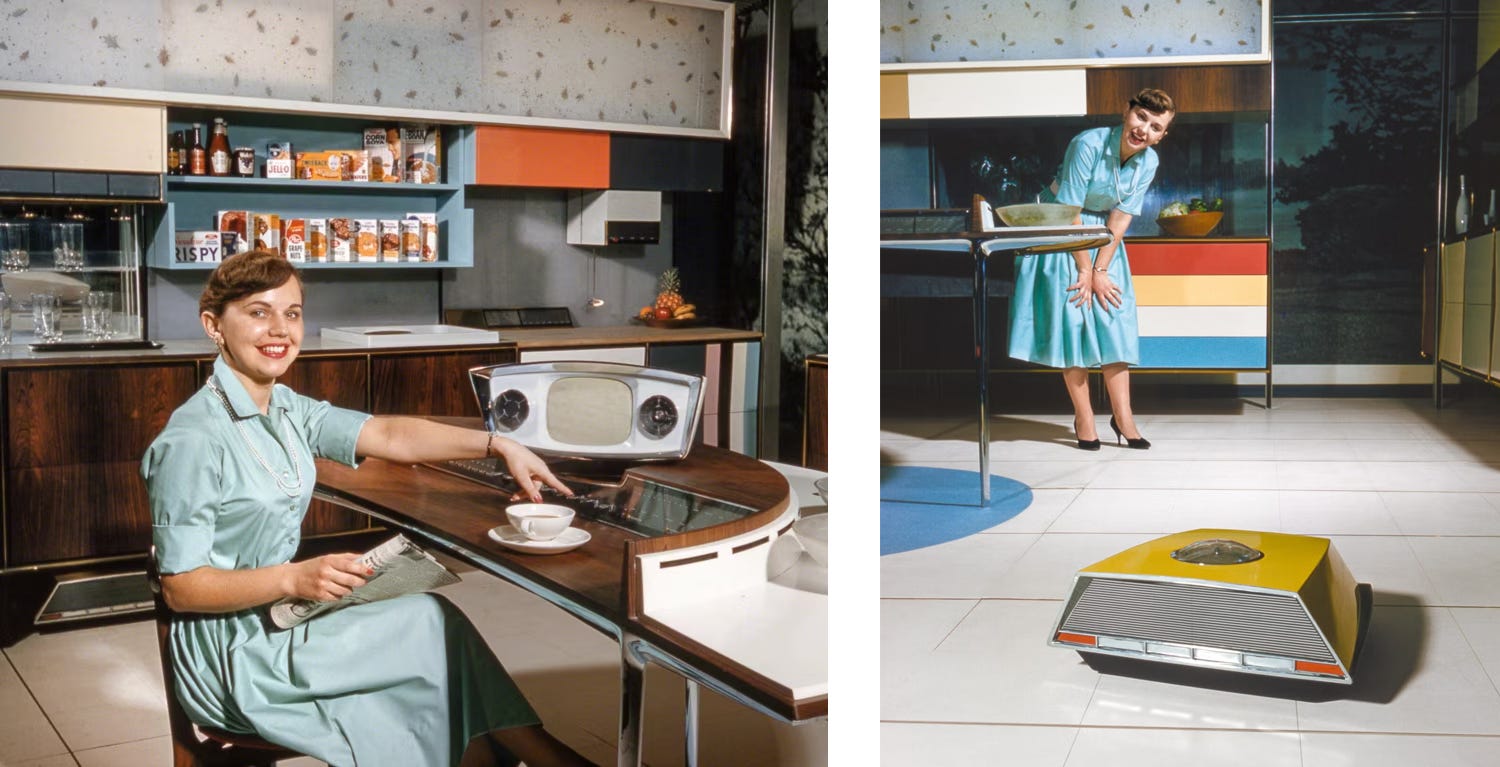
Exhibits of modern art and an early IBM computer continued the futuristic tone. Most dazzling was the RCA/Whirlpool Miracle Kitchen, a Jetsons fantasia complete with video telephone, self-propelled serving cart, and an early ancestor of the Roomba.
But it was the less spectacular Typical American House that would spark a historic confrontation. This reconstruction of an actual ranch house in upstate New York included “some 1,000 diverse furnishings,” the New York Times reported, including at least one from Hammacher Schlemmer.
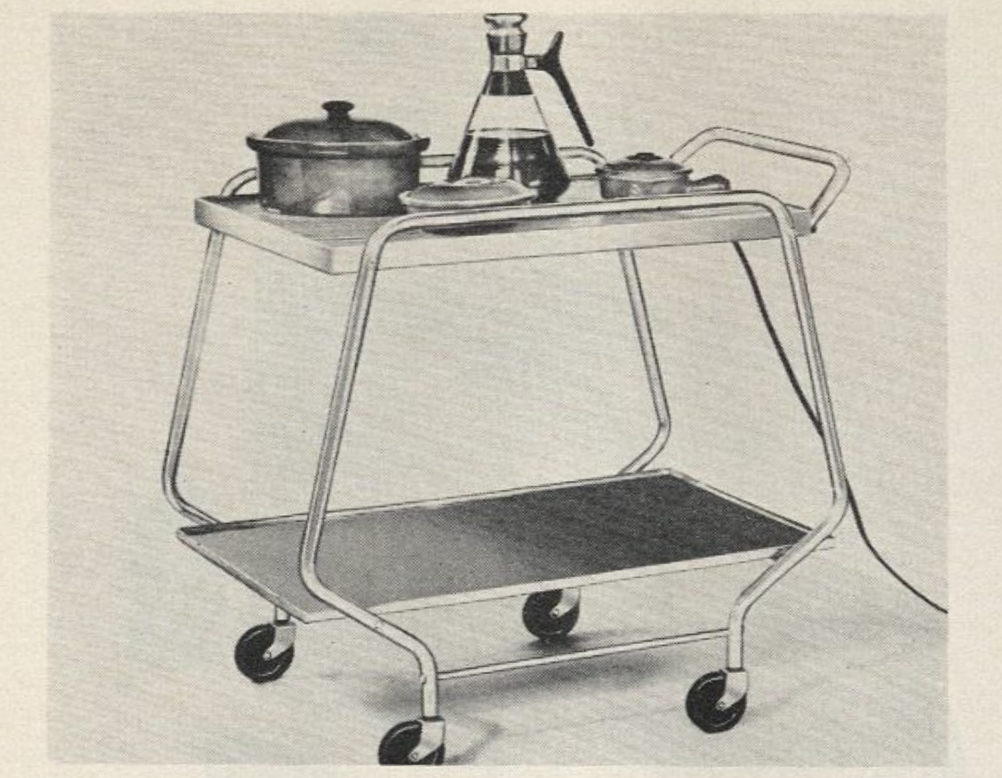
“DOUBLE-DUTY TABLE is one of many that ‘do things’ sent to the show,” the paper wrote. “It is on wheels, has a top that heats. By Salton. $57.50. At Hammacher Schlemmer.”
This electric warming cart was the Royal Salton Hotable, featured in our catalogue for several years around this time. “Meals on wheels kept hot on shatterproof radiant glass, thermostatic control,” ran our sales copy in the clipped cadence of the catalogue format. Its price of $57.50 (about $657 today) and modern trapezoidal styling would have positioned it at the aspirational end of the market.
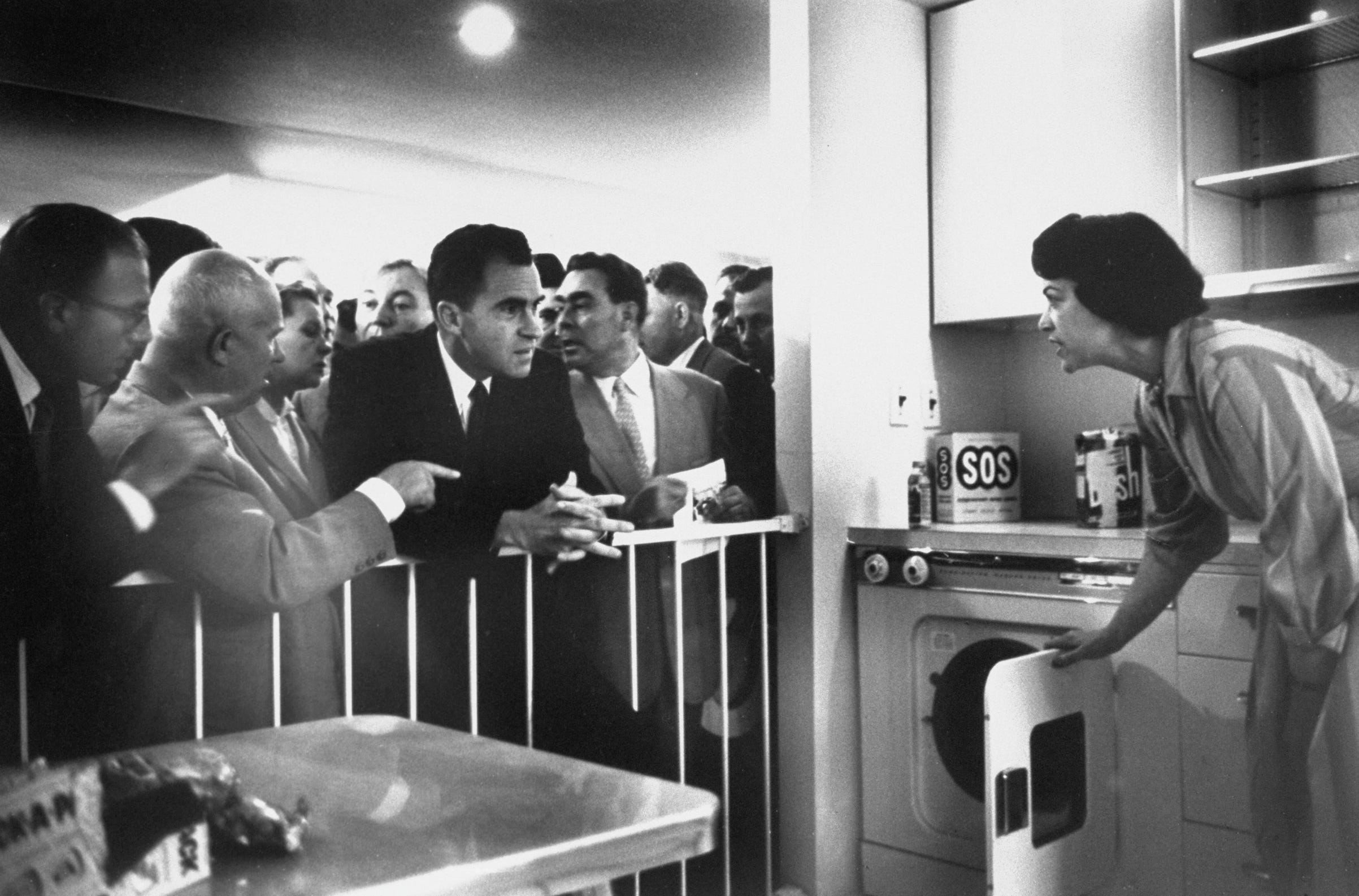
On July 24, 1959, as US Vice-President Richard Nixon showed Soviet Premier Nikita Khrushchev around the model home, the two began verbally jousting over the legitimacy of the display, and, by extension, their rival systems. “Any [American] steelworker can afford this house,” summed up Nixon’s argument; “In another seven years, we will be on the same level as America,” countered Khrushchev.
The status of women was a particular sticking point. Pointing to a dishwasher, Nixon contended “In America, we like to make life easier for women.” Khrushchev retorted, “Your capitalistic attitude toward women does not occur under Communism.” Notably absent from the discussion was the perspective of any actual women from either country.
The drama was irresistible: a frank, off-the-cuff running debate between two high-level officials of the world’s biggest superpowers. Television cameras captured it all. The “Kitchen Debate”, as it became known, was later shown on TV in both countries, another unprecedented moment of unscripted cross-ideological communication.
Historians differ on the impact of the Kitchen Debate. Did it raise the Soviet population’s expectations for consumer goods, increasing pressure on the Khrushchev regime, as US officials hoped? Was its main legacy the elevation of Richard Nixon in the public eye, leading eventually to his presidency? Or was the exhibition’s biggest effect the introduction of Pepsi-Cola to the Soviet market?
We’ll let the experts settle that one. What the American Exhibition of 1959 does prove is that the cornucopia of American innovation wasn’t complete without something from Hammacher Schlemmer.
Your own kitchen of tomorrow awaits in our Kitchen & Dining department.