

Home sweet White House… when the presidential mansion changes hands, it’s only natural for the incoming occupants to want to put their own stamp on where they’ll be dwelling for the next four or eight years. But as Patricia Nixon prepared to become the new lady of the house in 1968, she maintained one of her predecessor Lady Bird Johnson’s plans: to have the closets redone by Hammacher Schlemmer.
On November 11, less than a week after her husband’s victory in the election, Pat Nixon swung by 1600 Pennsylvania Avenue to begin figuratively measuring the drapes. Lady Bird Johnson showed her around the living quarters, which Pat hadn’t even visited when Richard Nixon was vice-president. “I have been here several times, but I have never seen the house as I have today,” Pat was quoted in an Associated Press wire-service story.
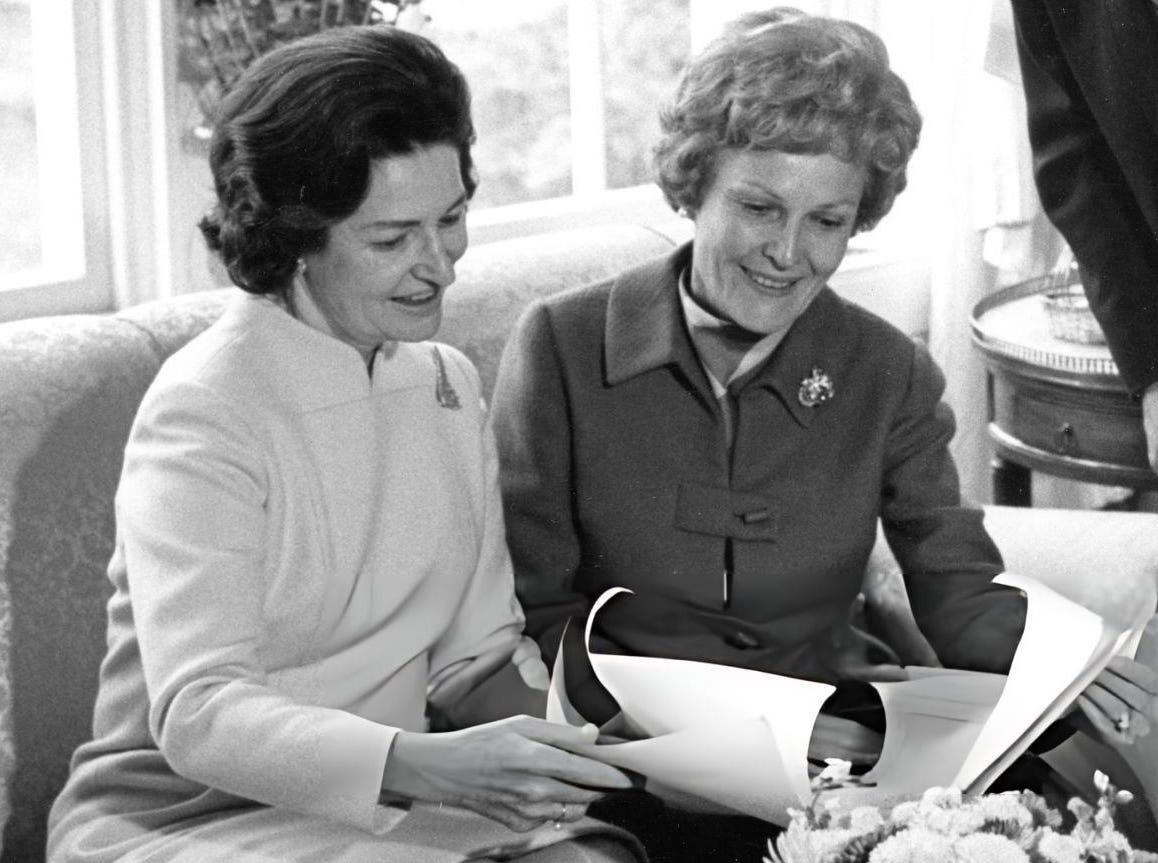
The AP also broke this massive scoop to a breathless public: “The tour brought out the first words that the White House closets were undergoing complete refurbishing by the New York firm of Hammacher Schlemmer as a gift to the nation.”
A Newsday article expanded on these Earth-shaking developments, quoting a Hammacher spokesman: “Many of the closets merely contained a shelf and a rod for hangers. Now we’re adding silk linings [and] fancy hangers, and moving rods and shelves to the side, and putting a mirror against the far wall to create spaciousness.”
In charging us with this mission, Lady Bird chose well. Way back in 1947, we’d started thinking of closets as a distinct space in the home with unique needs. The Closet Shop opened that year in our Manhattan store, headed by interior designers Kim Hoffmann and Steven Heidrich. The New York Times noted that we offered “suggestions and blueprints, as well as the actual execution of designs.”
In one display closet, a carousel-like rotating rack featured “three hanger rods arranged in a triangle about a center pole that revolves on ball bearing parts so that all the clothing is easily reached.” Hats, bags, and belts all had their own place, along with a shoe rack in the platform base.
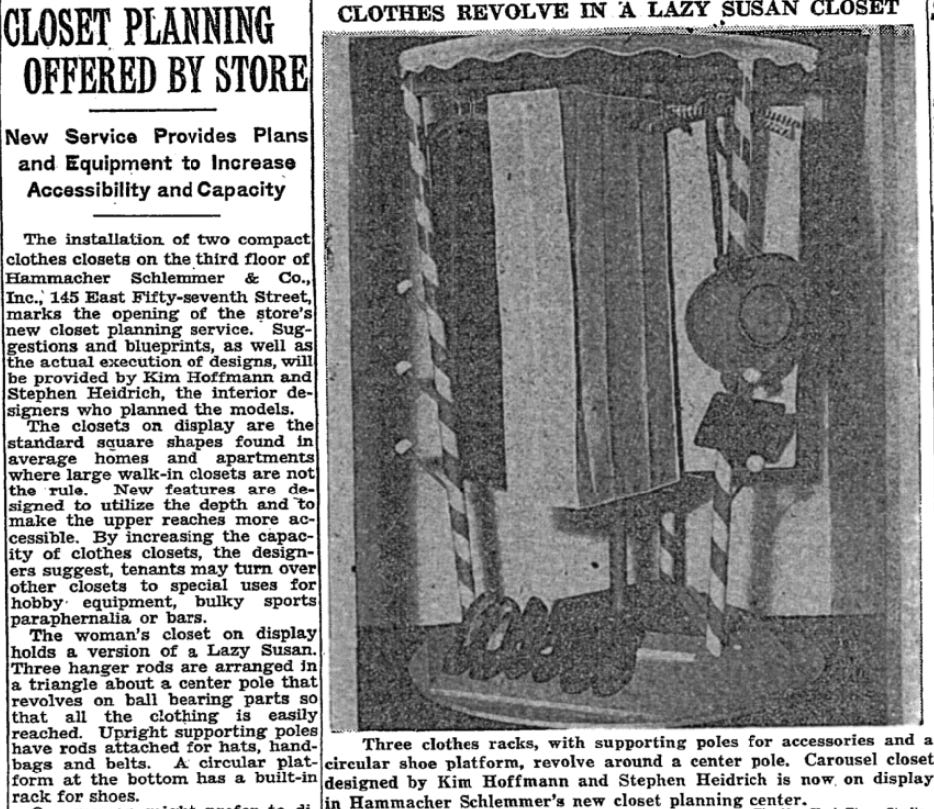
That fixation on space efficiency, for “average homes and apartments where large walk-in closets are not the rule,” stood us in good stead when it came time to work on that most un-average of American homes. After all, the White House was completed in 1800. If you’ve ever lived in an old house, you can imagine how deficient the storage space must be.
We’d love to show you exactly what we accomplished. Alas, detailed photos of the Executive Residence are thin on the ground. I suppose it wouldn’t do to share too much public knowledge of the quarters where the president and family sleep at night. But we’re sure our organizing wizards conjured new dimensions inside those cramped 18th-century closets, carousel or no.
Today, of course, custom closets make up an ever-booming industry unto itself, worth some $63 billion annually. The best-seller list is cluttered with sermons about the life-changing magic of clear plastic bins. All we can say is, what took everyone so long? Well before California Closets or The Closet Factory, some 40 years before Marie Kondo was even born, our Closet Shop was helping American families tame their unruly cupboards and cabinets - all the way up to the First Family.
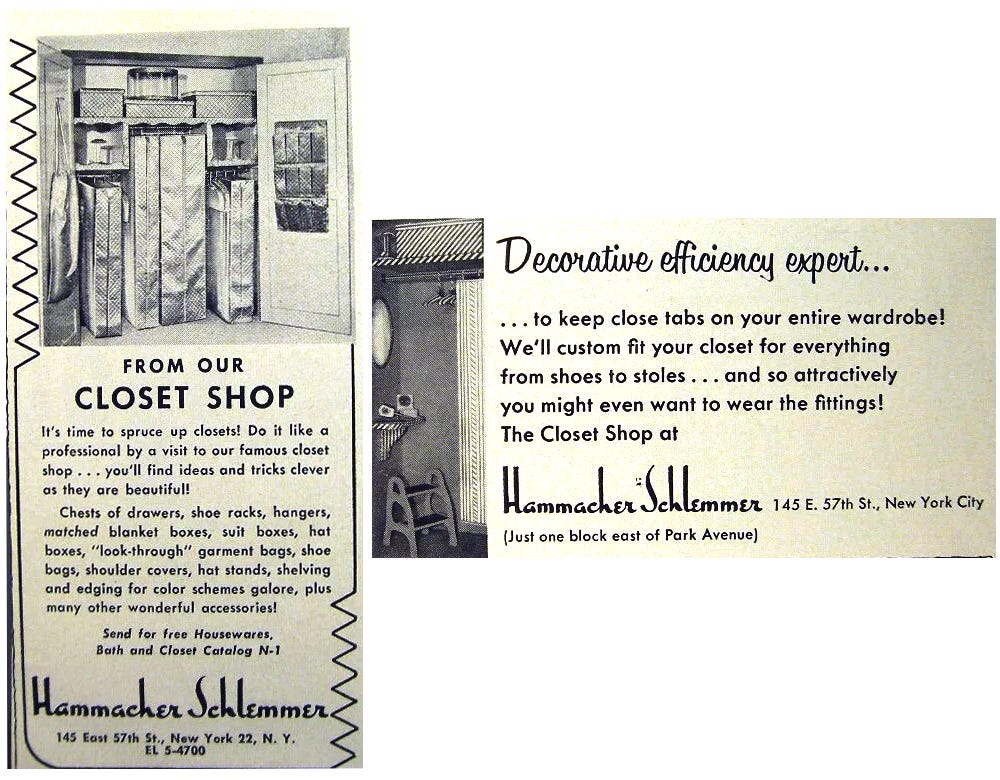
Ye Olde Hammacher Closet Shop is closed, but we’re still well-stocked with organizers, racks, and other stress-reducing space-savers.
And if you like Gnomenclature, you should know about Shoddy Goods, Jason’s other newsletter. It tells similar stories about consumer culture and history, but drawn from the rest of the world outside Hammacher Schlemmer. It’s about as fun as your Inbox can get.